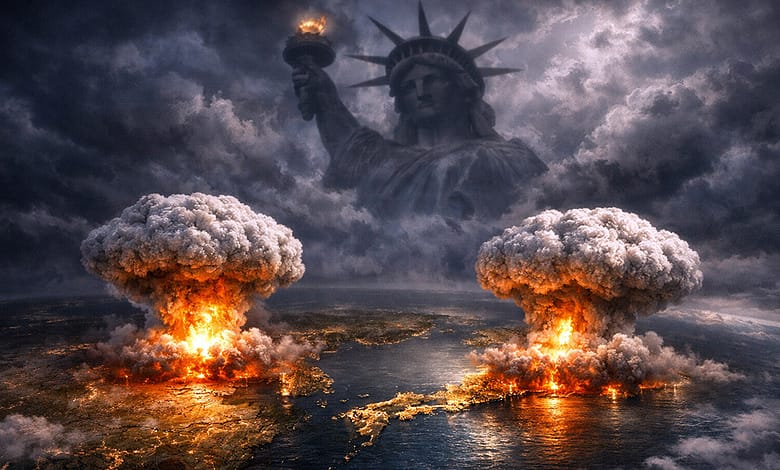
In the sweltering newsrooms of New Delhi, where we have watched empires rise and crumble through the cracked lens of the Non-Aligned Movement, one truth stands out like a mushroom cloud on the horizon: the United States of America is the only country in human history that has ever dropped nuclear weapons on innocent civilians. Twice. In 1945. On Hiroshima and Nagasaki. More than two hundred thousand souls, men, women and children turned to ash in the blink of an eye. And yet, for eight decades since, Washington has appointed itself the world’s nuclear sheriff, ready to bomb, sanction, invade or topple any government that dares reach for the same weapon. North Korea, that cartoonish ‘rogue’ state with its parades and missiles, has never fired one in anger. Pakistan, the ‘failed terror state’ we in India know only too well, has kept its arsenal holstered through four wars with us. The contrast is grotesque. The hypocrisy is blinding. The question that should haunt every thinking person is brutally simple: what is America actually afraid of?
Let us be clear from the outset. This is not about denying the horrors of nuclear weapons. Any sane person who has walked through the peace museums of Hiroshima or spoken to the survivors of Pokhran’s long-term health scars knows the terror these devices represent. But when the only nation that has ever used them lectures the rest of humanity on restraint while toppling governments that merely dream of acquiring them, we are not witnessing responsible global leadership. We are witnessing the naked logic of empire.
The pattern is now so familiar it feels scripted. A country, usually in the Global South, usually sitting on oil or strategic real estate, shows signs of mastering the atom. American intelligence goes into overdrive. Sanctions follow. Then the drumbeat in the Western media: ‘existential threat’, ‘madman dictator’, ‘weapons of mass destruction’. Finally, either bombs fall or regime change is engineered. Iraq 2003 remains the textbook case. Saddam Hussein, once America’s favourite secular strongman against Iran, suddenly became the new Hitler because he supposedly possessed nuclear ambitions. Colin Powell waved that vial of white powder at the United Nations. Millions marched in protest across the world. The invasion happened anyway. No nuclear weapons were found. The real weapons of mass destruction turned out to be the ones dropped by American B-52s conventional, yes, but delivered with the same casual arrogance that once flattened Japanese cities. Libya followed the same script with a cruel twist. Muammar Gaddafi, after watching what happened to Saddam, voluntarily surrendered his nuclear programme in 2003, handed over his centrifuges, and was welcomed back into the international fold. Eight years later, NATO bombs turned Tripoli into rubble and Gaddafi was sodomised with a bayonet in a drainpipe. The message to every leader from Tehran to Pyongyang was crystal clear: give up your nukes and we will still destroy you.
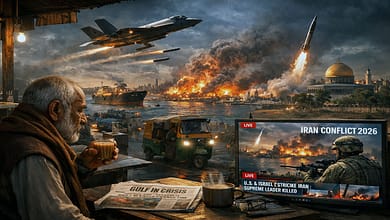
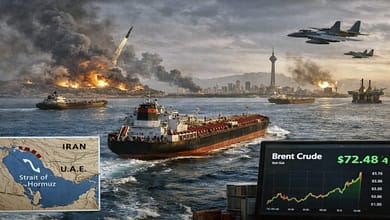
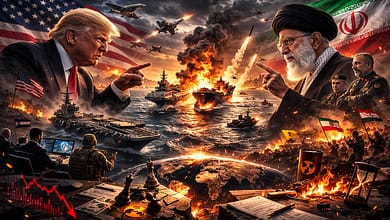
Iran has lived this nightmare in slow motion for decades. Sanctions that crush the Iranian middle class, cyber-attacks on its nuclear facilities, the assassination of scientists, constant threats of Israeli or American strikes. All because Tehran insists on enriching uranium to levels that dozens of other countries Japan, Germany and Brazil routinely do for power generation. Meanwhile, Israel, which never signed the Nuclear Non-Proliferation Treaty and is believed to possess between 80 and 400 warheads, receives $3.8 billion in annual American military aid without a single question asked. The double standard is not a bug. It is the operating system.
North Korea offers the most damning counter-example. Kim Jong-un’s regime is everything Washington claims to hate: dynastic, repressive, unpredictable. Yet the moment Pyongyang demonstrated a credible nuclear deterrent and the ability to reach American soil, the talk of regime change evaporated. Suddenly it was all ‘strategic patience’, summits in Singapore, and awkward handshakes. The lesson for every small nation watching is elementary: if you want to sleep at night without American special forces kicking down your door, you need the bomb. America understands deterrence perfectly when it applies to itself.
Pakistan is the exception that proves the rule. Despite being the world’s only nuclear-armed country born out of religious partition, despite its deep links with terror groups that have attacked India repeatedly, despite AQ Khan’s nuclear bazaar that sold technology to anyone with cash, Islamabad has never faced the kind of existential pressure Tehran or Baghdad endured. Why? Because Pakistan was useful. First as a Cold War bulwark against India and the Soviet Union, then as a logistics hub for the Afghan jihad and later as a supposed ally in the ‘war on terror’. Utility, not morality, decides who gets to keep their nukes. India itself felt the sting of American sanctions after our 1998 tests. For a brief period, we were the new pariahs, until Washington realised, we could be a counterweight to China. Then came the civil nuclear deal, the NSG waiver, and the sudden discovery that India was a ‘responsible’ nuclear power. The transformation was almost magical. Responsibility, it turns out, is measured in alignment with American strategic interests, not in any universal code of conduct.
So, what is the United States actually afraid of? Not the weapons themselves. America maintains the world’s largest nuclear arsenal, thousands of warheads on hair-trigger alert, many still on the same submarines and bombers that once circled the Soviet Union. It refuses to adopt a no-first-use policy while demanding that others do. It modernises its arsenal with new low-yield ‘usable’ warheads even as it preaches disarmament. The fear is not proliferation. The fear is parity.
Nuclear weapons are the ultimate equaliser. They make invasion prohibitively expensive. They force superpowers to negotiate instead of dictate. They allow a country of 25 million people to stare down an empire of 330 million and say: “You cannot touch me.” For a nation that has spent the last 80 years treating the planet as its backyard, intervening in Korea, Vietnam, Grenada, Panama, Somalia, Afghanistan, Iraq, Libya, Syria, Yemen and countless covert operations, this is an existential nightmare. America’s foreign policy rests on the assumption that it can project power anywhere, anytime, with minimal risk to its own homeland. Nuclear-armed adversaries shred that assumption. They raise the cost of American adventurism to the level of national survival. That is what Washington cannot tolerate.
Look at the map. Every country America has tried to disarm or destroy had the temerity to challenge American hegemony in its own region, Saddam’s Iraq threatening petrodollar control, Gaddafi’s Libya pushing for an African gold dinar, Iran’s resistance axis blocking Israeli and Saudi dominance. North Korea, for all its grotesque governance, simply wanted to be left alone after watching what happened to its neighbours. The ‘rogue’ label is applied not to those who pose a genuine threat to humanity but to those who pose a genuine threat to American freedom of action.
This is not abstract theory. It is lived reality for those of us in the Global South. We remember how the same voices that now warn about Iranian nukes once armed Saddam with chemical weapons during the Iran-Iraq war. We remember how Pakistan’s nuclear scientist AQ Khan was protected while India’s scientists were sanctioned. We remember how the NPT itself was designed as a permanent caste system, five permanent nuclear haves, the rest forever have-nots. India rejected that apartheid in 1974 and 1998, and the sky did not fall. Instead, we built a responsible minimum deterrent with a strict no-first-use doctrine. Pakistan followed. Even North Korea, for all its bluster, has used its arsenal only for survival, never for conquest.
The deeper tragedy is that America’s obsession with preventing proliferation has actually made the world more dangerous. By proving that denuclearisation invites regime change, Washington has incentivised every ambitious leader to race for the bomb as fast as possible. By maintaining its own massive arsenal while preaching restraint, it has destroyed the moral authority needed for genuine disarmament. By waging war after war on flimsy pretexts, it has reminded the world that the real rogue actor is not the one building centrifuges in the desert but the one dropping bombs from 30,000 feet while claiming to defend civilisation.
Having come to a sobering conclusion, that America is not afraid of nuclear war. It is afraid of a world where it can no longer start conventional wars at will. It is afraid of empowered nations that can say ‘no’ and make it stick. It is afraid of losing the monopoly on violence that has defined the American century.
The solution is not more sanctions or more pre-emptive strikes. It is not another round of lectures from Washington about ‘responsible behaviour’. The solution is radical honesty. Let America admit what the rest of the world already knows: the nuclear problem is not that too many countries have the bomb. The nuclear problem is that one country refuses to give it up while demanding everyone else remain defenceless. Until Washington is willing to discuss its own arsenal with the same urgency it applies to Tehran or Pyongyang, the rest of us will continue to see its non-proliferation crusade for what it is, a sophisticated protection racket dressed up as moral leadership.
The bombs that fell on Japan in 1945 did not just end a world war. They began an era of nuclear exceptionalism whose bitter harvest we are still reaping. North Korea never dropped a bomb. Pakistan never dropped a bomb. India never dropped a bomb. Only one country did. And it has spent every year since trying to ensure no one else ever gets the chance to even the score. That, more than any missile test or reactor diagram, is the real story of nuclear proliferation in our time.