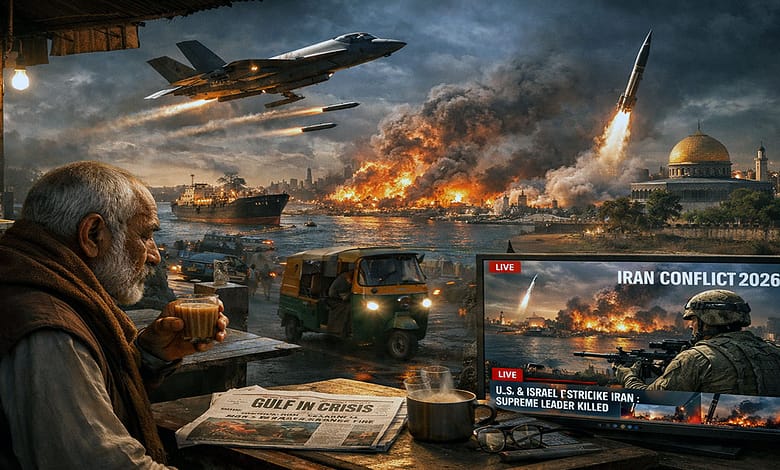
A cool March evening settles over Delhi. The air smells faintly of chai and dust and traffic crawls through the familiar chaos of horns and headlights. At tea stalls, people scroll through news updates while discussing cricket scores, stock prices, and politics. But today, much of the conversation is about something happening far away.
The Persian Gulf is on fire again.
Since February 28, 2026, American and Israeli warplanes have been striking Iranian military infrastructure under what Washington calls Operation Epic Fury. Stealth fighters have ripped through Iranian airspace, missile depots have been flattened, and naval installations have been hit. In one dramatic strike early in the campaign, Iran’s Supreme Leader was reportedly killed when his compound was destroyed.
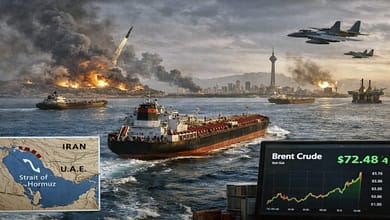
Iran responded almost immediately. Ballistic missiles have targeted US bases in Bahrain and Kuwait. Drone swarms have harassed tankers moving through the Strait of Hormuz. Hezbollah rockets have begun flying toward Israel.
Oil prices are spiking, global markets are jittery and diplomats everywhere are scrambling to stop a wider regional war.
Watching this unfold from India brings a sense of déjà vu. It’s not just another crisis, it feels like another episode in a long-running geopolitical series where the plot barely changes. The United States, the world’s most powerful nation, once again finds itself deep inside a conflict far from its own borders.
And honestly, if history had a reaction button, it might just say: we’ve seen this before.
Pattern Older Than the Superpower
The idea of America stepping into foreign conflicts didn’t start in the modern era. The pattern goes back to the Mexican-American War of 1846, one of the earliest examples of how geopolitical ambition and national narratives can mix.
President James K Polk placed US troops in a disputed border area between Texas and Mexico. When fighting broke out, he told Congress that Mexico had attacked American soil. War followed.
The United States won decisively, gaining enormous territory that now includes California, Nevada, Utah, and much of the American West. But historians still debate whether the war was defensive or simply expansionism wrapped in patriotic messaging.
A few decades later, something similar happened during the Spanish-American War of 1898. When the US battleship Maine exploded in Havana harbour, American newspapers blamed Spain and stirred up public anger. “Remember the Maine!” became the rallying cry.
Spain lost the war quickly, but the aftermath was messy. The Philippines, newly under American control, erupted in a brutal insurgency. What had been framed as liberation turned into a harsh colonial conflict that killed hundreds of thousands.
Even at that early stage, the blueprint was forming: a dramatic trigger, public outrage, military action and consequences far more complicated than the initial story suggested.
Vietnam, Iraq and the Long Echo of Intervention
The two world wars elevated the United States into a global superpower, and with that power came a much larger role in world affairs.
America entered World War I after German submarines sank ships carrying American passengers, including the Lusitania. President Woodrow Wilson framed the war as a mission to defend democracy. But the harsh peace imposed afterward helped create the conditions that eventually led to World War II.
By the Cold War era, intervention had become part of America’s geopolitical toolkit.
The clearest and most painful example was the Vietnam War.
In 1964, the Gulf of Tonkin incident was presented as a direct attack by North Vietnamese forces on American ships. Congress quickly authorized military escalation. Later investigations suggested that at least one of the alleged attacks may never have occurred.
The result was a decade of devastating conflict. More than half a million American troops fought in Southeast Asia. Napalm and airstrikes scarred the countryside. Over 58,000 Americans died, and millions of Vietnamese civilians were killed.
At home, the war shattered public trust and sparked massive protests. The economic strain fuelled inflation, and American society became deeply divided.
When Saigon finally fell in 1975, the war ended with helicopters lifting people from rooftops, a powerful symbol of a superpower forced to leave without victory.
If Vietnam taught one lesson, it was that military power alone cannot easily reshape complex societies.
Yet history has a strange way of repeating itself.
After the September 11 attacks, the United States invaded Afghanistan, initially to dismantle al-Qaeda and capture Osama bin Laden. Over time, that mission expanded into an enormous nation-building project.
Two decades later, when American forces withdrew in 2021, the Taliban returned to power within weeks.
Then there was Iraq in 2003, justified by claims that Saddam Hussein possessed weapons of mass destruction and had links to terrorist groups.
Those weapons were never found.
The invasion toppled Saddam, but it also triggered sectarian violence that destabilized the region and helped give birth to ISIS. The war cost trillions of dollars and severely damaged America’s credibility abroad.
Looking back, the pattern becomes hard to ignore. Each intervention begins with urgency and certainty. Each promises swift success. And many end with long, complicated aftermaths.
If global politics had a ‘history recap’, this would definitely be the highlight reel.
Iran and the Risk of Another Endless Conflict
That history makes the current confrontation with Iran feel eerily familiar.
Tensions between Washington and Tehran have been building for years. The United States withdrew from the Iran nuclear agreement in 2018 and reinstated harsh economic sanctions. In 2020, an American drone strike killed Iranian general Qassem Soleimani, escalating tensions dramatically.
Since then, Iran has steadily increased uranium enrichment while facing severe economic pressure and periodic domestic protests.
The February 28 air campaign was the most dramatic escalation yet.
Washington argues the strikes were necessary to prevent Iran from developing nuclear weapons. Officials claim intelligence showed Iran was approaching a nuclear breakthrough.
But some analysts question that timeline. Several experts believe Iran’s program had already been slowed by sanctions, cyber operations and earlier sabotage.
If that’s true, the justification for war begins to sound uncomfortably similar to the arguments that preceded the Iraq invasion.
Meanwhile, the immediate consequences are spreading fast.
Iran’s missile strikes have targeted American bases across the Gulf. Drone attacks threaten oil tankers in the Strait of Hormuz, one of the world’s most vital shipping routes. Hezbollah’s involvement raises the possibility of a wider regional war.
Oil prices are climbing rapidly, sending shockwaves through global markets.
For countries like India, the impact is direct. India relies heavily on energy imports from the Gulf, and any disruption in shipping routes can push fuel prices higher and strain the economy.
In a globalised world, conflicts in one region ripple across continents almost instantly.
And if this war drags on, those ripples could become waves.
The Question the World Keeps Asking
Why does this cycle continue?
Part of the answer lies in America’s belief in its global role. Since the end of World War II, many US leaders have argued that American power is essential for maintaining international order.
Supporters say this leadership prevents chaos.
Critics argue it sometimes creates new crises.
There are also structural forces at play. The American defence industry is massive, and military spending fuels an enormous network of contractors, technology firms, and political interests.
Then there is domestic politics. Foreign conflicts can temporarily unite public opinion and shift attention away from internal challenges.
But those effects rarely last.
Eventually the costs appear financial, human, and political.
From India’s vantage point, the pattern raises difficult questions. India’s foreign policy tradition has long emphasized diplomacy and strategic autonomy rather than intervention in distant conflicts.
That philosophy emerged from a simple understanding: history often punishes nations that overextend their power.
The British Empire once dominated global trade and military power, only to gradually retreat after the costs of maintaining that dominance became unsustainable.
Even superpowers are not immune to historical gravity.
Which brings us back to the present moment.
The Iran conflict is still unfolding. Washington predicts a short campaign. Military planners warn it could last much longer, especially if regional militias and proxy groups join the fight.
If Iran’s leadership structure collapses, the result might not be stability but another unpredictable power vacuum.
The world has seen that movie before.
For now, people everywhere from Delhi’s chai stalls to Washington’s policy circles are watching closely.
And somewhere in the background, history seems to whisper a familiar question:
How many times can the same story repeat before the lesson finally sticks?