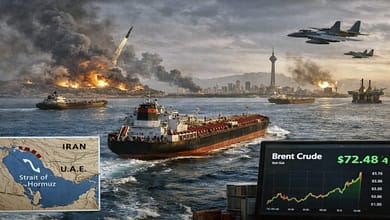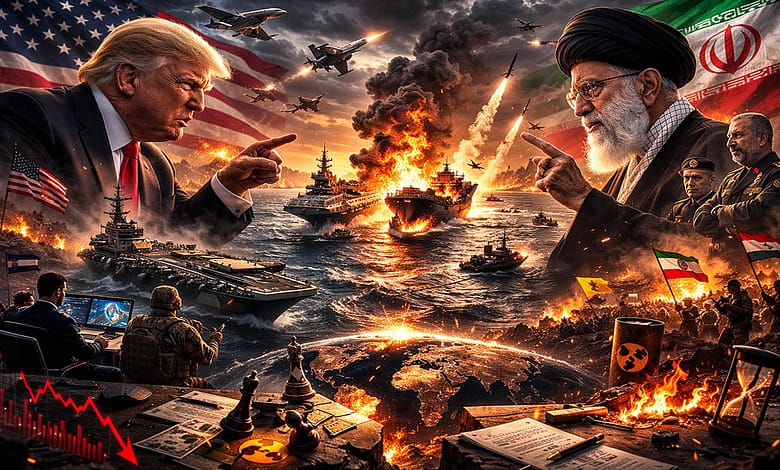
Right now, the Persian Gulf is giving full ‘endgame energy’. Near the Strait of Hormuz, basically the world’s oil Wi-Fi where nearly 20% of global oil passes every day, the United States and Iran are standing one wrong move away from a disaster that wouldn’t stay local. As of February 21, 2026, US President Donald Trump has issued Iran a hard 10–15 day deadline to agree to a nuclear deal or face what he called ‘really bad things.’ This isn’t empty talk. The US has deployed its largest naval and air buildup in the region since the 2003 Iraq war, with aircraft carriers, stealth fighters and hundreds of advanced jets entering the Gulf zone.
Iran, already weakened by Israeli and US airstrikes on its nuclear facilities in 2025 and dealing with massive internal unrest after violently suppressing nationwide protests, is now reinforcing underground nuclear sites and running live-fire military drills. At the same time, Iran briefly disrupted parts of the Strait of Hormuz, sending a clear message that global energy security is directly tied to what happens next. This situation isn’t just geopolitical drama, it’s a high-risk moment where the global economy, oil prices and regional stability are all on the line.
This isn’t posturing or ‘just vibes’. This is decades of unresolved US–Iran conflict, proxy wars, sanctions, and broken diplomacy stacking into a moment where one miscalculation could spiral into a full-scale international crisis. The real question dominating global politics right now is whether the US and Iran can de-escalate through direct talks without Iran relying on Russia and China, or whether that absence actually makes failure more likely.
If diplomacy fails, the immediate danger is a US or Israeli military strike on Iran’s nuclear and missile infrastructure. Sites like Natanz, Fordow, and Isfahan are already heavily fortified, but they remain prime targets. Any attack would almost certainly trigger retaliation, and Iran’s response would not be limited to one battlefield. Iran’s regional allies would activate across the Middle East, turning a ‘targeted strike’ into a multi-front war involving Israel, US military bases in the Gulf and major shipping lanes.
This is where the Strait of Hormuz becomes the world’s biggest problem. Even a short disruption through naval mines, missile threats, or tanker attacks, would send global oil prices soaring past $150 per barrel almost instantly. That kind of shock would hit inflation worldwide, crash stock markets and push already fragile economies into recession. Europe would face energy shortages, Asian manufacturing would slow down and global supply chains already strained by the Ukraine war and Red Sea attacks could start collapsing.
Beyond conventional warfare, the conflict could expand into cyber warfare and economic sabotage. Iran has a track record of cyberattacks against energy companies, banks and infrastructure. A retaliatory cyber campaign could disrupt US power grids, ports, pipelines or financial systems, creating chaos far beyond the battlefield. Any accidental radioactive leakage from damaged nuclear sites would trigger global outrage and diplomatic backlash, pulling neutral countries into the crisis and isolating Washington politically.
Russia and China also loom in the background. Russia could quietly supply Iran with advanced air defence systems, making US air operations longer and more costly. China, Iran’s largest oil buyer, could help Tehran bypass sanctions and stabilize its economy behind the scenes. A prolonged conflict would fracture global energy markets and deepen divisions between major world powers, pushing the international system closer to open bloc confrontation.
What makes this moment especially intense is that diplomacy is already happening quietly and indirectly without Russia or China involved. Talks mediated by Oman have taken place in Muscat and Geneva, using backchannel communication between US and Iranian officials. Oman’s role is critical because it is trusted by both sides and has historically helped broker sensitive US–Iran negotiations, including the early groundwork for the 2015 nuclear deal.
This negotiation format is intentional. By excluding Russia and China, Washington is trying to prevent Iran from leveraging great-power backing to stall or dilute concessions. The goal is a faster, cleaner agreement focused purely on nuclear limits, sanctions relief and regional de-escalation. History shows this approach can work when pressure is high and options are limited.
Still, the obstacles are serious. Iran’s leadership has publicly rejected the idea of zero uranium enrichment, framing it as a loss of sovereignty. Hardliners within Iran see compromise as weakness, especially after recent domestic crackdowns. In the US, any deal will face heavy political scrutiny, particularly from Congress and Israel, which demands strict verification and enforcement.
Iran’s expected counterproposal is likely to focus on partial concessions and time-buying tactics rather than full compliance. If the US rejects it, military action becomes more likely. If Iran walks away, the risk of strikes increases just as fast. Once diplomacy collapses, the escalation path becomes extremely difficult to stop.
At this stage, the US and Iran do not need Russia or China to negotiate. The communication channels exist, the mediation framework works and the consequences of failure are obvious. What’s missing is political willingness on both sides to accept an imperfect but enforceable deal instead of chasing total victory.
This isn’t just another Middle East crisis. This is a potential global energy shock, economic disruption, cyber conflict and humanitarian disaster wrapped into one moment. As the deadline approaches, the world is watching a high-stakes confrontation where every decision has worldwide consequences. If diplomacy fails, the fallout won’t stay regional, it will hit fuel prices, markets and daily life across the planet. The only real question now is whether leaders act before the situation explodes, or whether the world learns once again that some crises don’t come with a second chance.